
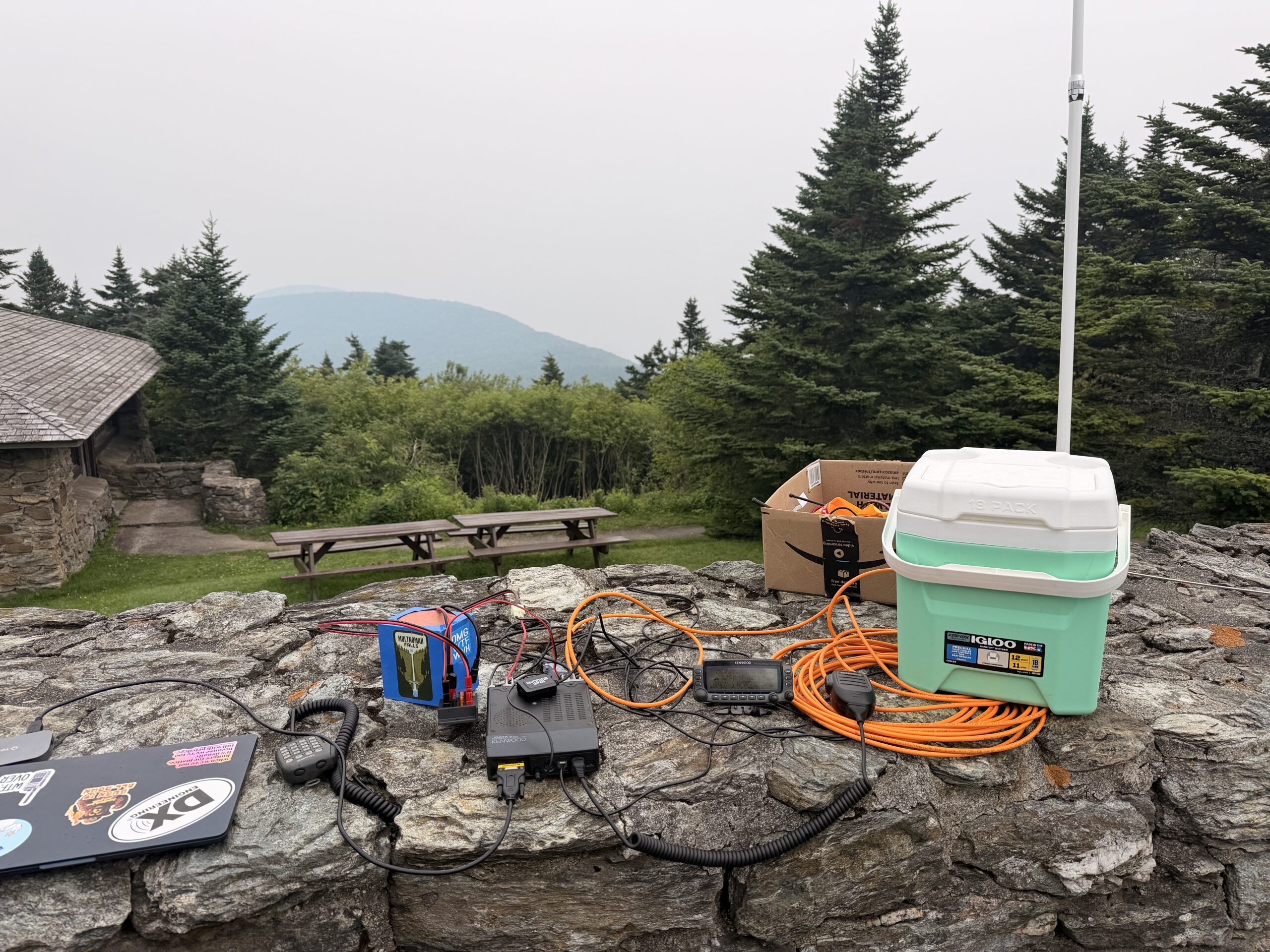

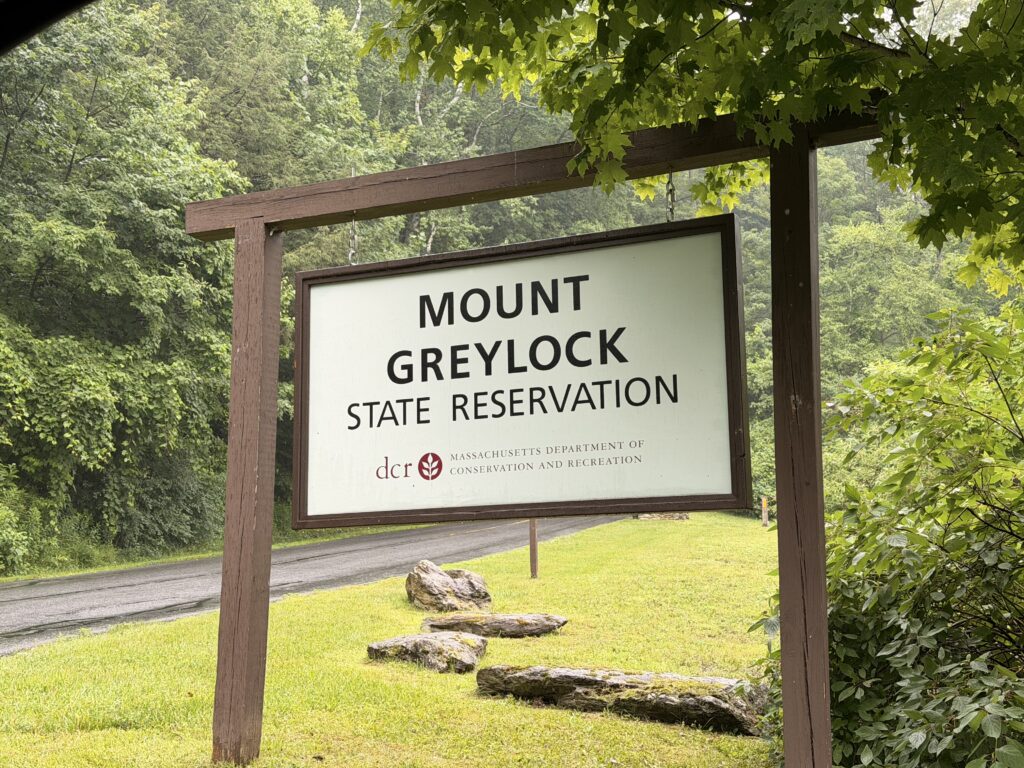
This year I took part in the Appalachian Trail Golden Packet (ATGP) event, from atop Mt. Greylock in Western Massachusetts.
ATGP is an annual event started by Bob Bruninga (WB4APR, silent key), the creator of APRS, in which a series of temporary mountaintop stations create a chain along the Appalachian Trail, from Springer Mountain in Georgia up through Katahdin in Maine.
The event was a success! Messages spanned the whole chain. Here is a map generated by John, KC1VMZ (my mentor in this!) of what was heard:
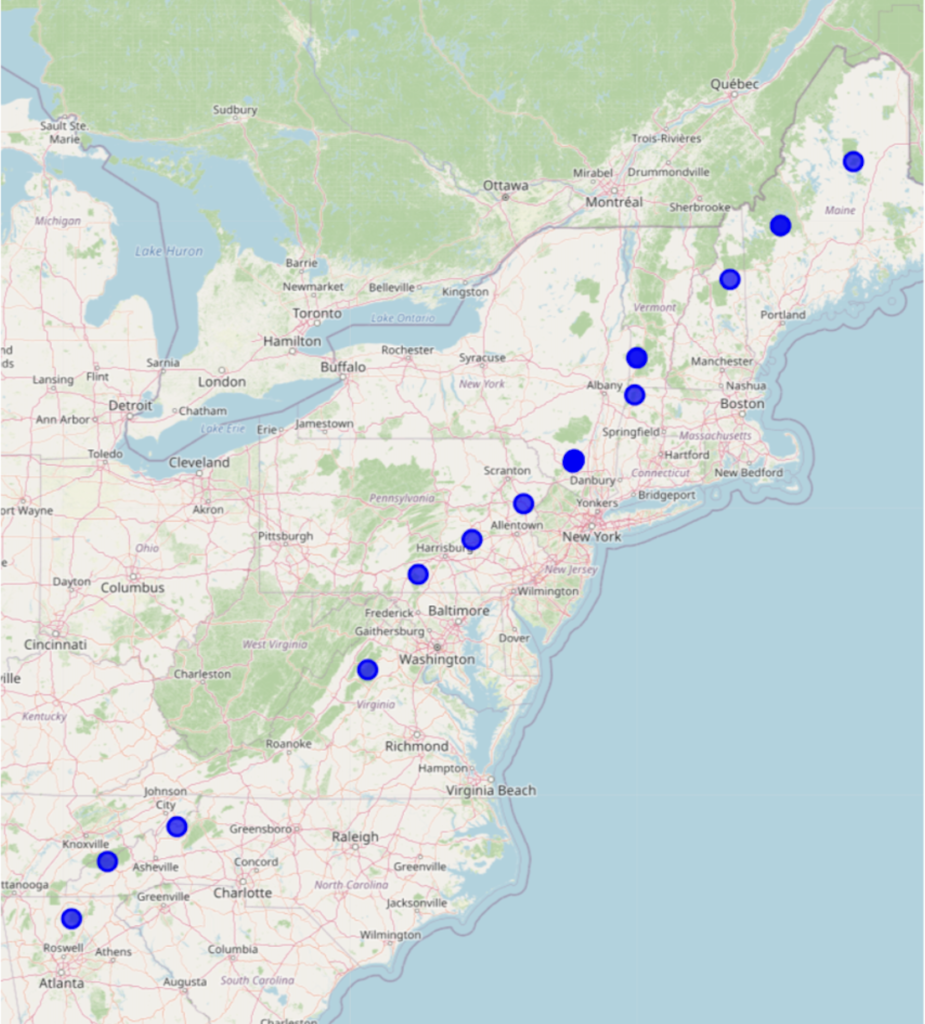
The suspiciously-large gap around Roanoke is a station (Apple Orchard Mountain?) that was clearly passing data, but didn’t seem to beacon, or at least wasn’t seen by some of us. There are several stations in the chain I never heard, and I don’t quite follow why. More on this a bit.
I arrived later than expected. We had a planned 10 am start time, and it was nearly 10:30 before I was on the air. It is an incredibly scenic drive, but the last bit is tedious if you’re in a hurry. It was right around 10:00 that I was in North Adams atop a big hill, seeing an FM broadcast antenna atop a short tower, thinking I was close. It was a fakeout: I then descended the hill, drove some distance before my GPS took me on what seemed like an obscure side street leading up to the entrance to Mount Greylock. The drive to the summit from Notch Road is nearly 7 miles.
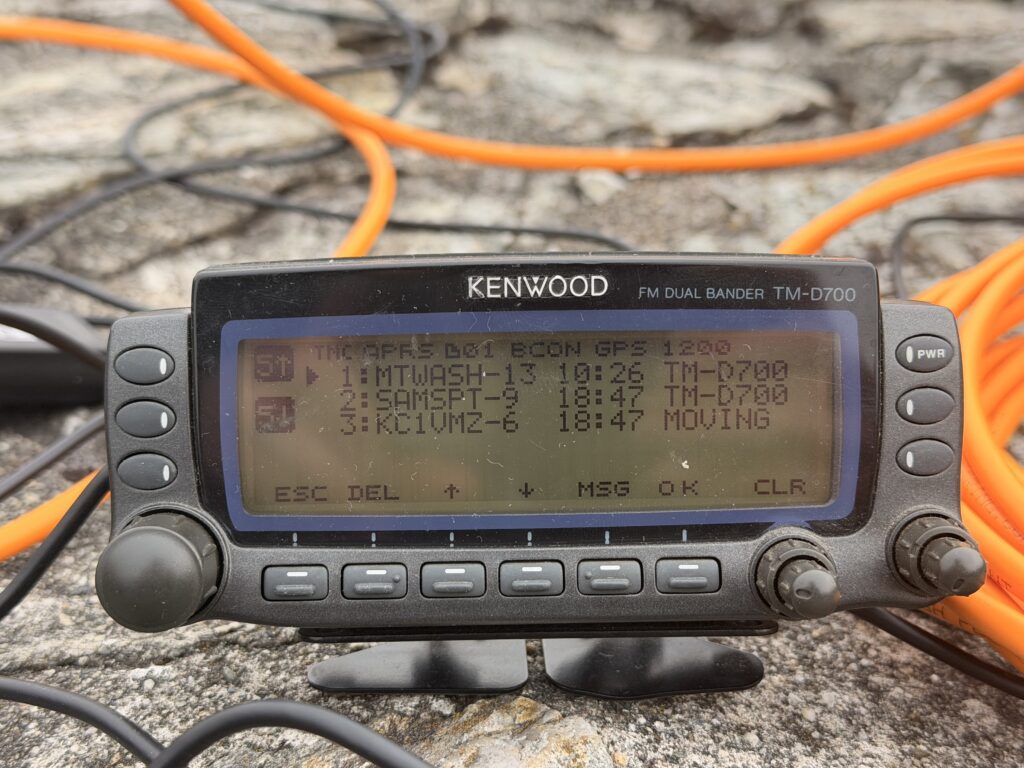
I quickly set up, and the first station I heard was Mt. Washington (MTWASH-13). (Note that the other two entries were from testing earlier in the week.)
I mentioned a hasty setup, and I mean it:
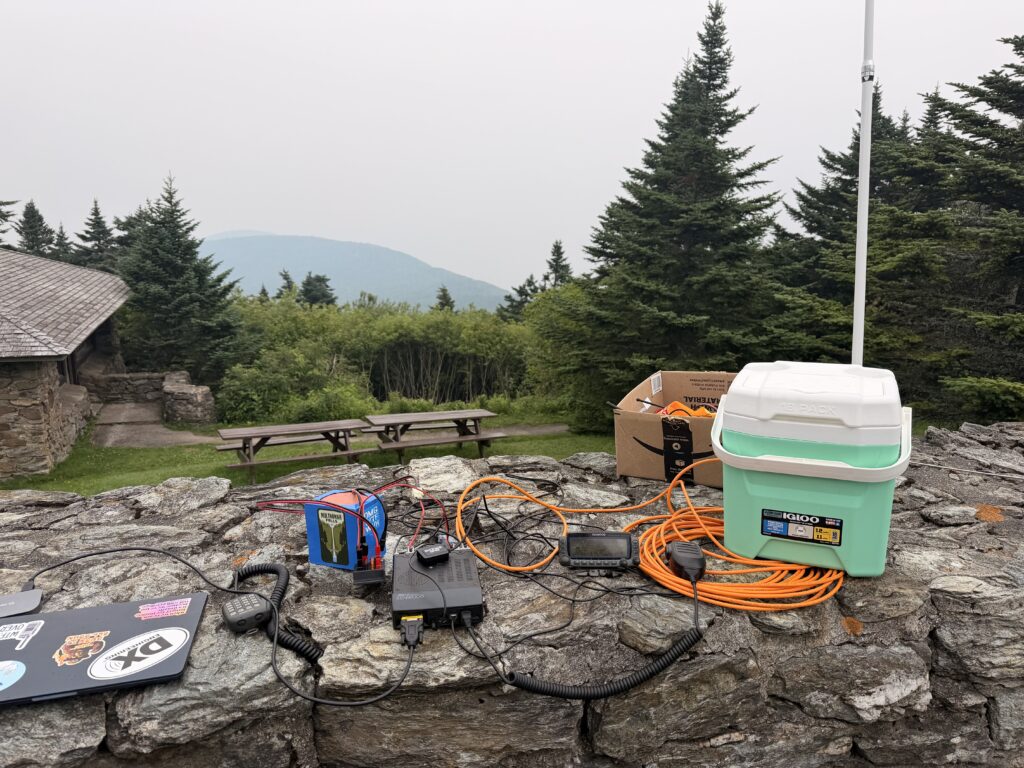
While almost all stations run a Kenwood TM-D710, I am a mere mortal with the older D700. A few folks had kindly offered to lend me a D710, but I felt it was best to stick with what I (mostly) knew.
I had purchased a Diamond X200 antenna at HRO, which may have been overkill, but it did not disappoint. It is probably not meant to be mounted directly on a rock wall, but it’s what I had. Note that the cooler and cardboard box are an important part of the setup, holding down two of the three ground plane radials. It got quite windy and would surely have tipped over otherwise. (Did I mention this was a hasty setup?)
I was able to confirm I was being heard by my neighbors to the south (John at Sam’s Point, NY, SAMSPT-9) and the north (Jeff on Mt. Equinox, VT, EQUNOX-12). The abbreviations are tactical callsigns we used. (For a legal ID, we set our beacon messages to include our FCC callsign.) The numbers are sequential, except that the first station (Springer Mountain) has no number, and there was no number 10 this year.
| Site | Location | First Heard |
|---|---|---|
SPRNGR | Springer Mtn, GA | 12:04 |
KUWOHI-1 | Kuwohi, TN | 12:56 |
ROAN-2 | Roan Mountain, TN | 12:11 |
PILOT-3 | Pilot Mountain, VA | Never |
AOMTN-4 | Apple Orchard Mtn., VA | Never |
WHTRCK-5 | White Rock Cliff, VA/WV | Never |
BGFLTS-6 | Big Flats Mtn, PA | 12:05 |
WEISER-7 | Weiser State Forest, PA | 12:11 |
CAMLBK-8 | Camelback Mtn., PA | 12:02 |
SAMSPT-9 | Sam’s Point, NY | 10:30 |
GRYLCK-11 | Mt. Greylock, MA | Me! |
EQUNOX-12 | Equinox Mtn., VT | 10:30 |
MTWASH-13 | Mt. Washington, NH | 10:26 |
SUGARL-14 | Sugarloaf Mtn., ME | 10:32 |
KATHDN-15 | Mt. Katahdin, ME | 12:05 |
I was not keeping a meticulous log as I was also fiddling with the radio, and running some discovery on the scanner on the side. But 12:05 was the moment I had seen both Katahdin and Springer, the northern and southern termini.
My understanding is that Camelback was delayed in setting up due to weather. This would be a recurring theme; Equinox would shut down shortly after 1pm due to lightning coming in, and Mt. Washington did the same shortly thereafter as winds were picking up. (Mt. Washington is, after all, the place where they had to chain down a building.)
I had already decamped my outdoor perch on the wall as a light drizzle suddenly gave way to fairly heavy rain. I was using a 50′ run of RG-58 coax, which I had bought for HF on Field Day / POTA. I regretted bringing this: it’s lossy at VHF/UHF, and the excessive length exaggerates that. It became optimal, though, as I was able to move my radio gear into my truck, leaving just the antenna and load-bearing cardboard box and cooler outside.
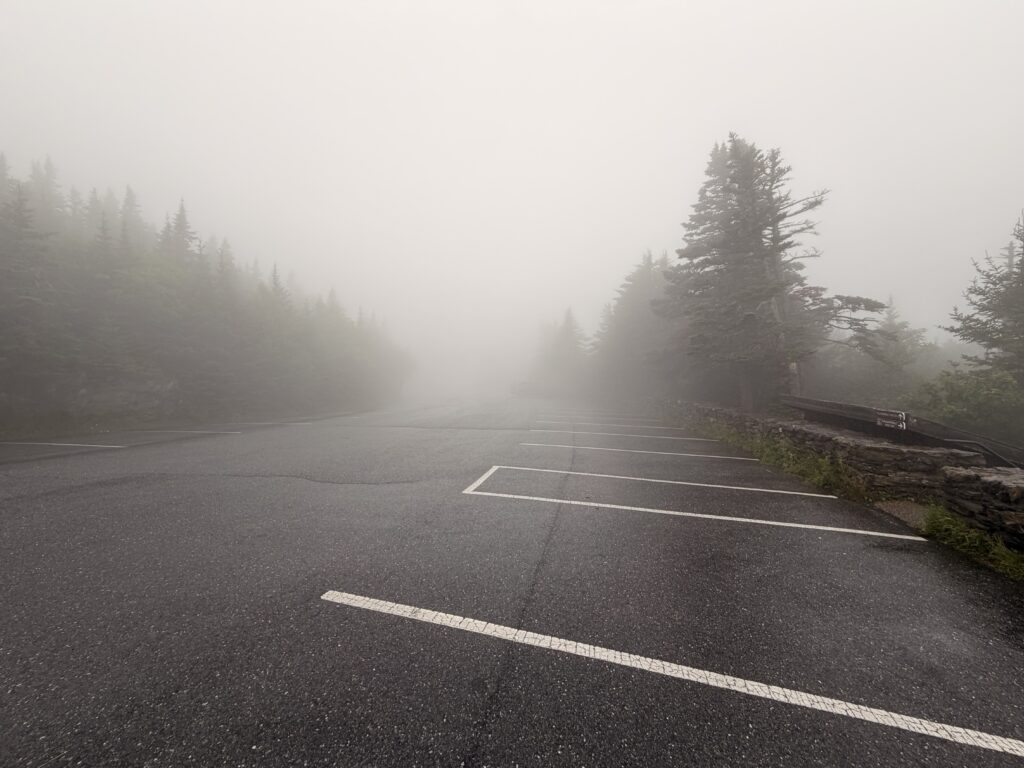
A dense fog followed the rain. Here’s what I was looking at after I shut down:
After stumbling my way through the fog (like Field Day all over), I decided to check out the war memorial, which had looked like a really neat structure but was a wee bit difficult to make out:
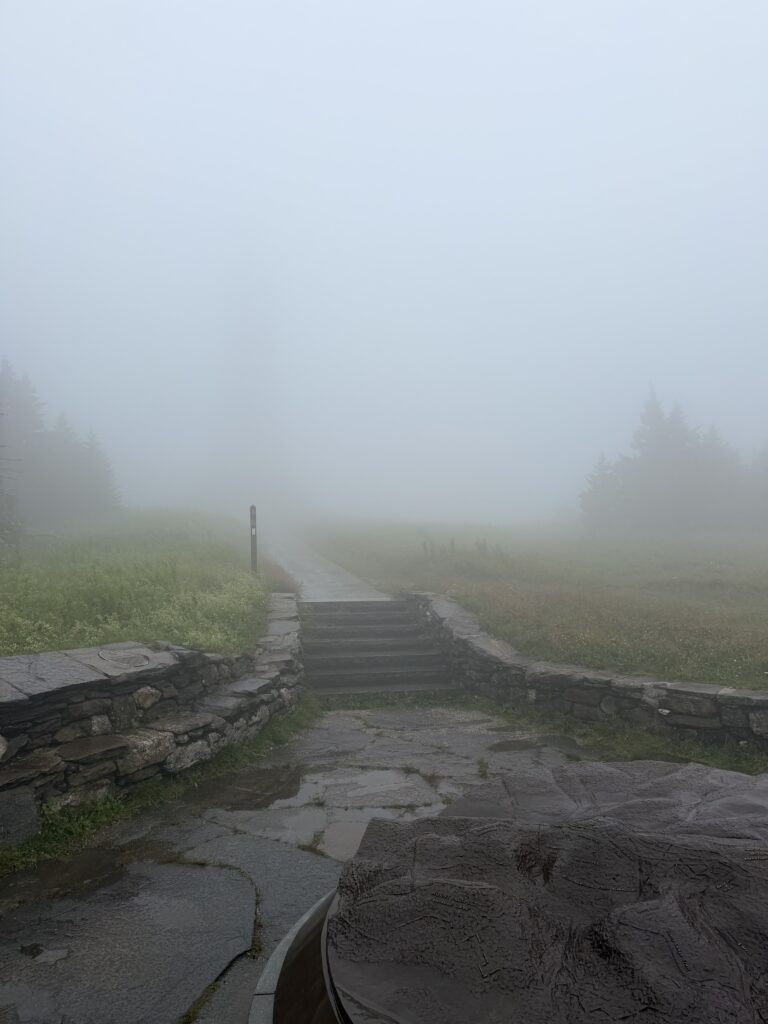
Through an easy-to-overlook nook, a small set of stairs leads to a dizzying spiral staircase. I felt compelled to make the visit as long as I was there:
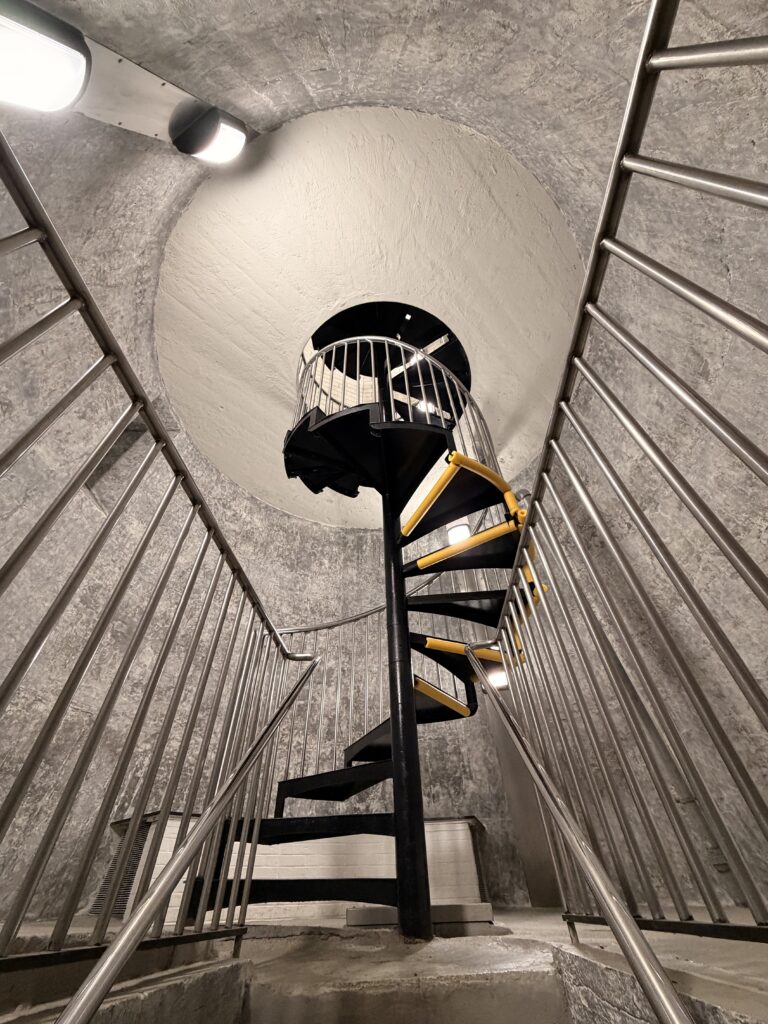
As was utterly predictable, the view from the windows at the top was entirely fog. I could just barely make out the ground outside. But even the trees between the parking lot and here were lost in the fog. The wind was howling through the… I’m not sure what… up there, making it feel really rather creepy.
It will be interesting to figure out why I never heard stations 3, 4, or 5. They were clearly working as traffic made it through them, but I never saw beacons from any of them. Jeff on Equinox reported the same, although it stands to reason that if I wasn’t seeing them, those past me also would not. It may have been as simple as them not beaconing, or it may be something like me goofing up a setting.
I could hear both Equinox and Mt. Washington on UHF FM. Jeff switched over to a handheld on Equinox and was still full-quieting. Mt. Washington was perhaps S5, but it was about 150 miles. I believe, but don’t have packet logs to confirm, that I was able to hear them directly on APRS as well. This suggests that if we were ever unable to man Mt. Equinox, we might be able to make things work, although that would mean we missed Vermont entirely.
There was good cell service on Greylock. This wasn’t the case at some northern sites, so I was able to relay information from email to the north. It was sort of fun: Jeff relayed the message from Equinox to Mt. Washington, and then I could hear Mt. Washington calling Sugarloaf—a sort of voice mesh.
I struggled to check into the ATGP-1 net, and in general found composing messages on the D700 very difficult. I think this may be why others used handhelds that got digipeated.
I also learned of graywolf, an APRS package building on direwolf but with a spiffy web UI. I already have a VHF CDM1250 to replace my club’s aging Maxtrac for APRS, and am thinking of giving graywolf a try with it. If I had more time, I would have loved to have had it set up for this, receive-only, so I could see what was actually being transmitted.